Can We Make Profit with 200x Leverage?
A complete guide to 200x leverage trading — how leverage works, its use in crypto and stock markets, real profit potential, liquidation risks, and what every trader must understand before using extreme leverage.
Can You Make Profit with 200x Leverage? The Complete Guide
The idea of turning a small amount of capital into life-changing profit overnight is what draws millions of traders toward high leverage trading. At the extreme end of this spectrum sits 200x leverage — a tool that can multiply a 0.5% price move into a 100% return on your margin, or wipe out your entire account in seconds. This guide explains everything you need to know: how leverage works mechanically, how it behaves in crypto versus stock markets, the real profit probability, and the risks that most traders ignore until it is too late.
Introduction: The Allure of 200x Leverage
Imagine placing a trade with just ₹1,000 and controlling a position worth ₹2,00,000. That is what 200x leverage does. Cryptocurrency exchanges like Bybit, BitMEX, and Binance Futures introduced extreme leverage ratios that were previously unimaginable for retail traders. The promise is simple — small capital, massive returns.
But here is the reality that advertisements never show: the same mechanism that multiplies your profits also multiplies your losses at exactly the same rate. At 200x, the market does not need to move against you by much. A mere 0.5% adverse move liquidates your entire position. Normal market fluctuations — the kind that happen every few minutes in crypto — are large enough to trigger a complete wipeout.
The question is not whether profit is possible with 200x leverage. It clearly is. The real question is: Is it consistently achievable? What does the math say? And who actually profits? This guide answers all of that.
How Leverage Works
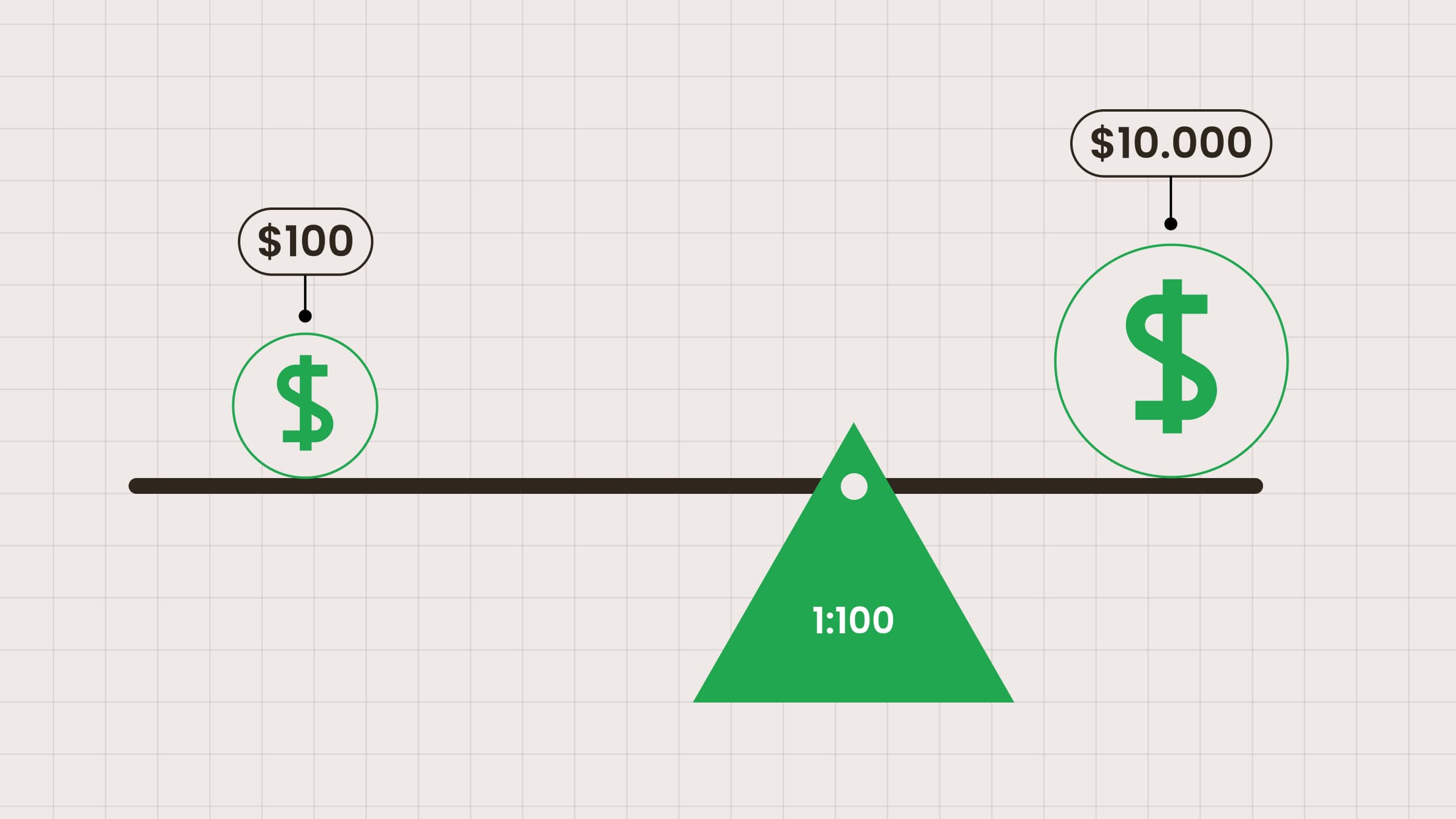
Leverage is the use of borrowed capital to increase the size of a trading position beyond what your own funds would allow. When you use 200x leverage, you deposit a small amount as margin (collateral), and the broker or exchange lends you the remaining capital to control a much larger position.
The Core Formula
The mechanics of leverage are straightforward:
- Position Size = Your Margin × Leverage Ratio
- Profit or Loss = Price Change % × Leverage Ratio
- Liquidation Threshold ≈ 1 ÷ Leverage (as a percentage move)
At 200x leverage, your liquidation threshold is approximately 0.5%. This means the market only needs to move 0.5% against your position before the exchange automatically closes it and you lose your entire margin.
A Worked Example
Suppose you deposit ₹10,000 as margin and open a 200x leveraged long position on Bitcoin:
- Your margin: ₹10,000
- Total position size controlled: ₹20,00,000
- Bitcoin price rises 0.5%: You profit ₹10,000 (+100%)
- Bitcoin price falls 0.5%: You lose ₹10,000 (full liquidation)
- Bitcoin price rises 2%: You profit ₹40,000 (+400%)
- Bitcoin price rises 5%: You profit ₹1,00,000 (+1000%)
The upside is extraordinary. But the liquidation zone — just 0.5% away — is where most retail traders end up, because normal market noise routinely exceeds 0.5% within minutes.
Key Leverage Concepts Every Trader Must Know
Margin
Margin is the actual capital you deposit as collateral to open a leveraged position. There are two types. Initial margin is the amount required to open the position. Maintenance margin is the minimum balance you must maintain to keep the position open. If your account balance falls below the maintenance margin, you face a margin call or automatic liquidation.
Liquidation
Liquidation occurs when your losses consume your margin and the exchange forcibly closes your position to prevent you from owing more than you deposited. At 200x leverage, liquidation happens almost instantly when the market moves against you even slightly. Most exchanges use a mark price — a smoothed average across exchanges — rather than the last traded price, to trigger liquidations. This prevents manipulation but does not protect you from rapid adverse moves.
Funding Rate
In perpetual futures contracts — the most common form of leveraged trading in crypto — a funding rate is charged or paid every 8 hours between long and short traders. When the market is bullish and more traders are long, longs pay shorts. When the market is bearish, shorts pay longs. At 200x leverage, even a small funding rate compounds quickly and can eat into your margin significantly over time.
Cross Margin vs Isolated Margin
Most exchanges offer two margin modes. Cross margin uses your entire account balance as collateral — if a position moves against you, the exchange draws from your full balance before liquidating. This gives you more buffer but puts your entire account at risk. Isolated margin limits the collateral to only the amount you assigned to that specific trade — your loss is capped at that amount, and the rest of your account is protected. For extreme leverage like 200x, isolated margin is strongly preferred.
Slippage
Slippage is the difference between the price at which you expected your order to execute and the price at which it actually executed. In fast-moving or low-liquidity markets, slippage can be significant — meaning your actual entry or stop-loss price may be worse than expected, compounding losses at high leverage.
| Leverage | Liquidation Threshold | Position on ₹10,000 Margin |
|---|---|---|
| 2x | 50% adverse move | ₹20,000 |
| 10x | 10% adverse move | ₹1,00,000 |
| 25x | 4% adverse move | ₹2,50,000 |
| 50x | 2% adverse move | ₹5,00,000 |
| 100x | 1% adverse move | ₹10,00,000 |
| 200x | 0.5% adverse move | ₹20,00,000 |
Leverage in Crypto Markets
Cryptocurrency markets are where extreme leverage has truly taken hold at the retail level. Exchanges such as Bybit, Binance Futures, BitMEX, OKX, and Bitget offer leverage ranging from 10x to 200x on major pairs like BTC/USDT and ETH/USDT. Some offshore and derivatives platforms go even higher on smaller altcoin pairs.
Why Crypto Offers Such Extreme Leverage
Crypto exchanges operate largely outside the regulatory frameworks that govern traditional financial markets. There are no central banks, no SEBI, no SEC oversight on most of these platforms. This regulatory gap allows exchanges to offer leverage that would be illegal for a stock broker to provide. Exchanges also profit from liquidations and trading fees, giving them a financial incentive to offer higher leverage.
The Unique Dangers of Crypto Leverage
Extreme Volatility
Bitcoin regularly moves 3%–8% within a single hour during volatile sessions. Ethereum and altcoins can move 10%–20% in a day. At 200x leverage, a 3% move means a 600% gain or a complete liquidation six times over your margin. Normal crypto market behavior is wide enough to liquidate 200x positions within minutes of entry, even when the eventual direction is correct.
24/7 Markets With No Circuit Breakers
Unlike stock exchanges that close at the end of the trading day, crypto markets operate continuously — 24 hours a day, 7 days a week, 365 days a year. A major news event at 3 AM — a regulatory announcement, an exchange hack, a whale dumping — can gap prices right through your liquidation level while you are asleep. There are no circuit breakers, no trading halts, no after-hours protections.
Funding Rate Costs
When bullish sentiment dominates the market, long traders pay a positive funding rate to short traders every 8 hours. Annual funding rates on popular leveraged tokens can range from 30% to over 100% in extreme bull markets. At 200x leverage, holding a position for even a day exposes you to significant funding cost relative to your margin.
Flash Crashes and Cascade Liquidations
Crypto markets are prone to sudden, violent price drops known as flash crashes. These are often triggered by a large sell order hitting a thin order book, which triggers stop-losses and liquidations at lower prices, which in turn trigger more liquidations — a cascade effect. During major crash events such as the March 2020 crash or the May 2021 sell-off, billions of dollars in leveraged positions were liquidated in a matter of hours. Traders holding 200x positions were wiped out in the first minute.
Exchange and Counterparty Risk
Many platforms offering 200x leverage are registered in jurisdictions with minimal regulation. Exchange insolvency (as seen with FTX in 2022), withdrawal freezes, and outright fraud are real risks. At high leverage, even a brief exchange outage during a volatile period can prevent you from closing a losing position, resulting in an avoidable liquidation.
Low Liquidity on Altcoins
200x leverage on small-cap or mid-cap altcoins is especially dangerous. Order books are thin, bid-ask spreads are wide, and price can be moved easily by a single large order. Market manipulation — pump and dump schemes, stop hunts by whales — is far more common in low-liquidity markets and directly targets leveraged retail positions.
Which Crypto Exchanges Offer High Leverage?
| Exchange | Max Leverage (BTC) | Max Leverage (Altcoins) | Regulation |
|---|---|---|---|
| Binance Futures | 125x | Up to 75x | Varies by country |
| Bybit | 100x | Up to 50x | Offshore (Dubai) |
| BitMEX | 100x | Up to 100x | Offshore (Seychelles) |
| OKX | 100x | Up to 50x | Offshore (Seychelles) |
| Bitget | 125x | Up to 75x | Offshore |
| Smaller DEX/Offshore | Up to 200x+ | Up to 200x+ | Unregulated |
How Crypto Leverage Actually Works in Practice
When you open a leveraged futures position on a crypto exchange, you are not buying or selling actual cryptocurrency. You are entering into a derivatives contract — specifically a perpetual futures contract in most cases — that tracks the price of the underlying asset. You never own the Bitcoin; you own a contract that profits or loses based on Bitcoin's price movement.
This distinction matters because it means there is no underlying asset to fall back on. If the contract moves against you, you lose your margin. There is no physical asset to hold and wait for recovery. The position is simply closed and your margin is gone.
Leverage in Stock Markets
In traditional equity markets, leverage exists but is tightly regulated and far more conservative than what crypto platforms offer. The mechanisms, terminology, and risk profiles differ significantly from crypto leverage.
How Leverage Works in Indian Stock Markets (F&O)
In India, leverage in equity markets is accessed primarily through the Futures and Options (F&O) segment on the NSE and BSE. SEBI strictly regulates the maximum leverage available to retail traders.
Intraday leverage (MIS — Margin Intraday Square-off) is provided by brokers for intraday equity trades. Most brokers offer 3x to 5x intraday leverage on select stocks. Positions are automatically squared off before market close — typically by 3:20 PM — if not closed manually.
Futures contracts offer inherent leverage through their lot-size structure. For example, a Nifty 50 futures contract requires approximately ₹1.1 lakh in margin to control a contract worth around ₹15 lakh — roughly 13x notional leverage. However, this is not the same as 200x leverage because daily Nifty moves of 0.5%–1% will not liquidate your position.
SEBI's peak margin rules, introduced in 2021, significantly tightened leverage by requiring traders to have the full margin available upfront rather than relying on intraday limits. This was designed specifically to protect retail traders from over-leveraging.
Common F&O Products in India
- Index Futures (Nifty, BankNifty, FinNifty): High liquidity, regulated leverage, settlement in cash
- Stock Futures: Leverage on individual stocks with SEBI-prescribed margin requirements
- Options Buying: Limited-loss leverage — your maximum loss is the premium paid, but options can expire worthless
- Options Selling: High margin requirement, theoretically unlimited risk, requires sophisticated risk management
How Leverage Works in US Stock Markets
In the United States, leverage in equity markets is regulated by FINRA and the Federal Reserve through Regulation T, which requires at minimum 50% initial margin for overnight stock positions — effectively a maximum of 2x leverage on stocks held overnight.
Pattern Day Traders (PDTs) — traders who make four or more day trades within five business days in a margin account with over $25,000 — are permitted 4:1 intraday leverage.
Leveraged ETFs such as TQQQ (3x Nasdaq), SOXL (3x Semiconductors), and SPXL (3x S&P 500) provide up to 3x daily leveraged exposure without requiring a margin account. However, these suffer from volatility decay — a mathematical erosion of value in choppy markets over time — making them unsuitable for long-term holding.
Futures trading in the US (S&P 500 E-mini, Crude Oil, Gold) offers significantly higher notional leverage — an E-mini S&P 500 futures contract controls $175,000+ in value with approximately $12,000–$15,000 in margin — but this is still far from 200x.
Stock Market vs Crypto: Key Differences in Leverage
| Feature | Indian Stock Market | US Stock Market | Crypto Market |
|---|---|---|---|
| Maximum Retail Leverage | 3x–5x intraday (SEBI) | 4x intraday (FINRA) | Up to 200x (offshore) |
| Regulatory Body | SEBI | FINRA / SEC / Fed | None (offshore) |
| Liquidation Process | Margin call, then square-off | Margin call, then forced sell | Instant automatic liquidation |
| Market Hours | 9:15 AM – 3:30 PM IST | 9:30 AM – 4:00 PM EST | 24/7/365 |
| Overnight Risk | Gap risk on next open | Gap risk on next open | Continuous, no gap protection |
| Typical Daily Volatility | 0.5%–2% | 0.5%–1.5% | 3%–15%+ |
| Funding / Interest Cost | Annual broker interest rate | Annual broker margin rate | Funding rate every 8 hours |
| Asset Ownership | Yes (underlying shares) | Yes (underlying shares) | No (derivatives contract only) |
| Investor Protection | SEBI, IPEF | SIPC, FINRA | None guaranteed |
Why Stock Market Leverage Is Safer Than Crypto 200x
The structural differences between regulated stock markets and unregulated crypto derivatives exchanges create a fundamentally different risk environment. In stock markets, lower maximum leverage combined with lower typical daily volatility means a single adverse day is very unlikely to wipe you out completely. You receive margin calls giving you time to respond. Markets close at the end of the trading day, providing a natural reset. Regulatory bodies provide a framework of investor protection that simply does not exist on offshore crypto exchanges.
This does not mean stock market leverage is without risk — it absolutely carries risk. But the risk is proportional, manageable, and bounded in a way that 200x crypto leverage is not.
Can You Actually Make Profit? The Math of 200x
Let us examine the mathematics of 200x leverage honestly, because the numbers tell a story that social media highlight reels never show.
The Liquidation Problem
At 200x leverage, your liquidation threshold is 0.5%. Bitcoin's average hourly volatility — the typical range of price movement in a single hour — is between 0.8% and 2% during normal market conditions. During volatile sessions, hourly moves of 3%–5% are common.
This means that on a typical day, even if your directional view on Bitcoin is correct for the next 24 hours, there is a very high probability that at some point during that day the price will temporarily move 0.5% against you — and that temporary move will liquidate your position before the price recovers in your favor. You are right about the direction but still lose all your money.
The Ruin Problem
Even if you have a genuine trading edge — say a 60% win rate, which is excellent — the ruin problem destroys you at 200x. If you allocate your full margin to a single 200x trade and it goes against you, your capital is gone entirely. You cannot recover from zero. A 100% loss requires an infinite return to recover. This is why professional risk managers call extreme concentration at high leverage the ruin problem — one bad trade ends everything regardless of your win rate.
Fees and Funding Rate Drag
Every trade at 200x incurs fees — typically 0.02%–0.06% taker fees per trade on most crypto exchanges. On a ₹20,00,000 position (₹10,000 margin at 200x), a 0.05% taker fee equals ₹1,000 — which is 10% of your margin gone immediately on entry, before the market moves at all. Round-trip (entry + exit) costs 20% of your margin. You need the market to move substantially in your favor just to break even after fees.
Statistical Reality
Studies of retail trader performance on leveraged platforms consistently show similar results across different markets and time periods. On crypto derivatives platforms, over 75%–85% of retail traders who use leverage above 20x lose money within 90 days. At 100x and above, the percentage of losing traders rises further. These are not outlier findings — they are consistent across Bybit, BitMEX, and publicly available exchange data.
| Scenario | Outcome |
|---|---|
| Market moves 0.5% against you | Complete liquidation — 100% loss of margin |
| Market moves 0.5% in your favor | 100% profit on margin (before fees) |
| Entry + exit fee cost (0.05% each side) | Approximately 20% of margin consumed by fees alone |
| Holding overnight — positive funding rate | Additional margin erosion every 8 hours |
| Retail traders losing money at high leverage (>20x) | 75%–85% within 90 days |
| Recovery needed after 1 full liquidation | Infinite — capital is gone |
How Professional Traders Use High Leverage
There is a meaningful difference between how retail traders use 200x leverage and how professional or institutional traders approach extreme leverage. Understanding this difference is the most important insight in this entire guide.
Micro Position Sizing Is Everything
A professional trader who uses 200x leverage does not put their full trading capital into a single 200x trade. They might allocate 0.1% to 0.5% of their total portfolio into a single position. This means that even if the trade is fully liquidated — a 100% loss on the position — the impact on their total account is just 0.1%–0.5%. Their effective leverage on their total portfolio is not 200x at all. It is 0.2x–1x — extremely conservative.
The 200x leverage is used purely to express a very precise, short-term directional view with a small amount of capital. The large position size amplifies the return on that small allocation, but the risk to the overall account is tightly controlled.
Precision Entry Based on Order Flow and Structure
Professional high-leverage traders do not enter positions based on momentum, social media sentiment, or chart patterns alone. They use order book analysis (identifying large bid and ask walls), liquidation heatmaps (understanding where clusters of stop-losses and liquidations are placed), and market microstructure (how price moves at specific levels) to identify high-probability, precise entry points where the probability of a 0.5% adverse move before their target is minimized.
Non-Negotiable Stop-Losses Set Before Entry
Every professional trade at high leverage has a stop-loss defined before the position is opened. At 200x, that stop-loss might be set at 0.2%–0.3% from entry — close enough to keep the loss small but chosen at a price level that, if reached, indicates the thesis is wrong. The stop-loss is never moved to give the trade more room. It is executed automatically and without emotion.
Quick Exits and No Overnight Holding
At 200x leverage, positions are held for minutes to hours — never days. The cost of holding (funding rates, fee drag, risk of overnight gaps) makes extended holding economically irrational at extreme leverage. Professionals take their profit at a predetermined target, exit, and move on. There is no holding for more upside, no averaging down, no hope-based position management.
Continuous Learning and Performance Tracking
Professional traders track every trade in a journal — entry price, exit price, leverage used, size, reason for entry, result, and lessons learned. They analyze their win rate, average profit per winning trade, average loss per losing trade, and maximum drawdown. This data-driven approach allows them to continuously refine their edge and identify when their strategy is working versus when market conditions have changed.
Risks You Cannot Ignore
Total Capital Loss in Seconds
This is not a theoretical risk — it is a near-certainty for traders who use 200x with full margin allocation. A 0.5% adverse move, which can happen within a single one-minute candle in crypto, eliminates 100% of your deposited margin. There is no warning, no time to react, no second chance. The liquidation is automatic and instantaneous.
Negative Balance Risk
Most reputable exchanges offer negative balance protection — a guarantee that your loss cannot exceed your deposited margin. However, not all platforms — especially smaller or offshore exchanges — offer this protection reliably. In extreme market conditions (flash crashes, extreme slippage), the exchange's insurance fund may be insufficient to cover all liquidated positions. In such cases, traders can theoretically be left with a negative balance, meaning they owe the exchange money beyond what they deposited.
Psychological Destruction
Repeated liquidations create a cycle of emotional decision-making that is difficult to break. After a liquidation, many traders immediately re-enter with a larger position to recover losses quickly — a behavior known as revenge trading. This almost invariably leads to further losses. The psychological impact of repeated wipeouts — anxiety, impulsive decisions, distorted risk perception — is often more damaging than the financial loss itself.
Timing Risk: Being Correct but Still Losing
This is one of the cruelest aspects of 200x leverage. You can be entirely right about the direction Bitcoin will move over the next 24 hours, but a temporary 0.5% fluctuation in the wrong direction in the first 10 minutes will liquidate your position before your thesis plays out. You are correct. The market eventually moves exactly as you predicted. But you lose all your money anyway because you could not survive the short-term noise.
Exchange and Counterparty Risk
The collapse of FTX in November 2022 — once the second-largest crypto exchange in the world — demonstrated that even major platforms can fail catastrophically. Billions of dollars in trader funds were lost. Platforms offering 200x leverage are frequently smaller, less established, and even more financially precarious than FTX was. The risk of exchange failure, withdrawal freezes, or outright fraud is real and must be factored into any decision to trade on these platforms.
Technical and Connectivity Risk
A slow internet connection, a browser crash, a platform outage, or a mobile app freeze at a critical moment can prevent you from closing a position or executing a stop-loss. At 200x leverage, missing a 30-second window to exit can mean the difference between a small loss and a complete liquidation.
Tips for Safer Leverage Trading
Tip 1: Start With Low Leverage — Always
Before ever touching 50x or 200x leverage, develop a consistently profitable approach at 2x–5x. If you cannot make money at 5x leverage, you will not make money at 200x — you will simply lose money faster. Low leverage forces you to develop genuine skill rather than relying on luck amplified by leverage.
Tip 2: Use Isolated Margin Mode, Never Cross Margin
Always use isolated margin when trading at extreme leverage. This ensures that if your position is liquidated, only the margin allocated to that specific trade is lost — not your entire account balance. Cross margin mode at 200x means a single liquidation can wipe everything you have on the exchange.
Tip 3: Treat Position Size as Your Primary Risk Control
Your real risk management tool is not your stop-loss — it is your position size. Keep each 200x trade to a maximum of 0.5%–1% of your total trading capital. This way, even if the trade is fully liquidated, your account survives and you can trade another day.
Tip 4: Never Trade 200x Without a Defined Stop-Loss
Set your stop-loss before you enter the trade, not after. Define exactly how much of your margin you are willing to lose — ideally 20%–30% of the position margin, not 100%. Use the exchange's stop-loss order feature to make it automatic. Never manually monitor a 200x position without an automated stop-loss in place.
Tip 5: Avoid High Leverage on Altcoins
If you insist on using extreme leverage, restrict it to the highest-liquidity pairs — BTC/USDT or ETH/USDT. These markets are deeper, have lower spreads, and are less susceptible to manipulation. Altcoin pairs with 200x leverage combine extreme leverage risk with thin-liquidity risk, creating conditions where losses can be catastrophic and unavoidable.
Tip 6: Study Liquidation Heatmaps
Tools like Coinglass display liquidation heatmaps — visual representations of where large clusters of stop-losses and liquidations are placed across the market. Understanding where price is likely to be attracted (to trigger these liquidations) helps you avoid placing your own position in zones where a stop hunt is likely to sweep you out.
Tip 7: Paper Trade First — Seriously
Most major exchanges offer testnet or paper trading environments where you can trade with simulated funds at any leverage. Spend at least 30–60 days paper trading your strategy at 200x before risking real capital. If you cannot be consistently profitable in paper trading — where there is no emotional pressure — you will not be profitable with real money where emotions are amplified.
Conclusion
Can you make a profit with 200x leverage? Yes — in specific, controlled conditions, it is possible. Professional traders with micro-position sizing, disciplined risk management, precision entries based on order flow analysis, and non-negotiable stop-losses can use extreme leverage as a tool to generate returns from small, high-conviction directional trades.
But for the overwhelming majority of retail traders, 200x leverage is not a wealth-building tool — it is a wealth destruction mechanism. The mathematics of liquidation at 0.5%, the cost of fees and funding rates, the psychological pressure of rapid losses, and the continuous 24/7 volatility of crypto markets create conditions where consistent profitability is extremely difficult to achieve and maintain.
The statistics are unambiguous: more than 75%–85% of retail traders who use high leverage lose money within 90 days. The rare traders who profit long-term do so not because of the leverage ratio they use, but because of the discipline they apply — small position sizes, hard stop-losses, quick exits, and relentless focus on protecting their capital above all else.
If you are new to trading, the right approach is to develop genuine skill and a real edge at 2x–5x leverage first. If you are experienced and want to experiment with higher leverage, use isolated margin, keep position sizes tiny relative to your account, and never risk more than you are prepared to lose completely.
The goal of trading is not to get rich on one trade. The goal is to stay in the game long enough to become skilled. Protect your capital. Trade with discipline. Leverage is a tool — and like all powerful tools, it rewards skill and destroys recklessness.
Frequently Asked Questions
Can you really make a profit with 200x leverage?▼
Yes, it is possible but statistically very difficult for retail traders. Professional traders who use 200x leverage allocate only 0.1%–0.5% of their total capital per trade, making the actual portfolio-level risk extremely small. For most retail traders who allocate full margin, a single 0.5% adverse price move causes complete liquidation. Studies show over 75%–85% of retail traders using leverage above 20x lose money within 90 days.
What is the liquidation price at 200x leverage?▼
At 200x leverage, your position is automatically liquidated when the market moves just 0.5% against your entry price. For example, if you open a long on Bitcoin at ₹50,00,000, a drop to ₹49,75,000 will wipe your entire margin. Bitcoin's average hourly price movement frequently exceeds 0.5%, meaning liquidation can happen within minutes of entry even in normal market conditions.
What is the difference between isolated margin and cross margin?▼
Isolated margin limits your loss on a specific trade to only the margin you allocated to that position — the rest of your account is protected. Cross margin uses your entire account balance as collateral, meaning a losing position can draw from all your funds before liquidation. At extreme leverage like 200x, always use isolated margin to cap your maximum loss per trade.
What happens if a crypto exchange goes bankrupt while I have a leveraged position?
Related Blogs
MACD Indicator: The Complete Guide — History, How It Works & TradingView Setup
A professional, in-depth guide to the MACD indicator — covering its history, how it works, signals it generates, and a step-by-step walkthrough to add and configure MACD on TradingView with screenshots.
RSI Indicator: The Complete Guide — History, How It Works & TradingView Setup
A professional, in-depth guide to the RSI (Relative Strength Index) indicator — covering its history, how it works, overbought and oversold signals, divergence, and a step-by-step walkthrough to add and configure RSI on TradingView.