Human vs AI in 2026: What Each One Actually Does Better
Human vs AI in 2026 — a clear, balanced look at what AI genuinely does better, what humans still do better, where the two work best together, and what it actually means for jobs, creativity, and decision-making.
The Wrong Question
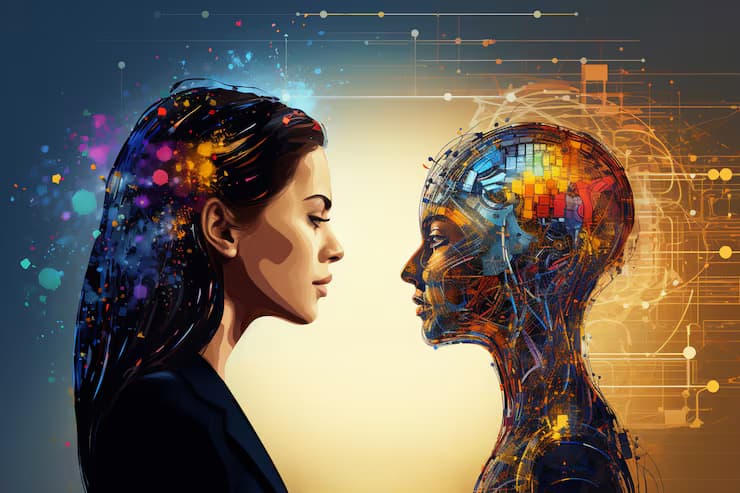
"Human vs AI" makes it sound like a competition with one winner. In practice, it's less of a battle and more of a division of labor AI is extraordinary at some things and genuinely bad at others, and the same is true of humans, just in reverse. Understanding exactly where each one wins is far more useful than picking a side.
AI doesn't think like a faster human. It processes like a machine that happens to sound human. That distinction explains almost every strength and weakness on both sides.
Where AI Wins, Clearly
Speed and Scale
AI can process millions of data points in seconds something that would take a team of humans weeks or months. Whether it's analyzing financial transactions for fraud or scanning medical images for anomalies, raw processing speed isn't close.
Consistency
AI doesn't get tired, distracted, or have an off day. The 10,000th task is performed with the same precision as the first no fatigue, no mood swings, no Monday morning slump.
Pattern Recognition at Scale
AI can spot subtle patterns across massive datasets that would be invisible to a human correlations across millions of records, early signals in market data, or anomalies buried in years of sensor readings.
Perfect Recall
AI doesn't forget. It can instantly retrieve and cross-reference information across enormous volumes of text, code, or data without the memory decay every human experiences.
Where Humans Still Win, Clearly
Genuine Creativity
AI generates output based on patterns in what already exists. Humans create from lived experience, emotion, and genuinely new perspective the kind of creative leap that isn't a remix of prior data, but something new born from a specific human life.
Emotional Intelligence
Reading a room, sensing when someone needs support rather than solutions, navigating a sensitive conversation this requires genuine empathy shaped by lived human experience, not pattern-matched responses.
Judgment in Ambiguity
When there's no clear data pattern to follow a genuinely novel ethical dilemma, a first-of-its-kind business decision humans reason through uncertainty in a way AI still struggles to replicate reliably.
Trust and Relationships
People buy from people, follow leaders they trust, and open up to those who've earned it. Trust built over time through consistent human behavior isn't something AI can substitute for, no matter how good the conversation feels.
A Side-by-Side Look
| Capability | AI | Human |
|---|---|---|
| Processing speed | Extremely fast | Slower, limited by cognition |
| Consistency | Perfect, no fatigue | Varies with energy and mood |
| Creativity from lived experience | Limited remixes existing patterns | Strong original, experience-driven |
| Emotional understanding | Simulated, pattern-based | Genuine, experience-based |
| Judgment under true uncertainty | Weak needs data patterns | Strong reasons through the unknown |
| Trust-building | Not applicable | Core human strength |
The Real Story: Collaboration, Not Competition
The most productive teams and businesses in 2026 aren't the ones trying to out-compute AI or the ones stubbornly avoiding it they're the ones who've figured out the right division of labor. Let AI handle the repetitive, data-heavy, pattern-based work at scale. Let humans handle the judgment calls, the creative direction, the relationships, and the decisions where context and experience matter more than raw data.
- AI drafts, humans decide first-pass content, code, or analysis generated by AI, refined and approved by human judgment
- AI processes, humans interpret AI surfaces patterns in data, humans decide what they actually mean for the business
- AI scales, humans build trust AI handles support at volume, humans step in for high-stakes or sensitive relationships
What This Means for Jobs
Most jobs aren't disappearing outright they're shifting. The mechanical, repetitive parts of many roles are increasingly handled by AI, while the human role moves toward directing, reviewing, and applying judgment to AI output. The people and businesses who adapt fastest aren't the ones resisting AI or blindly trusting it they're the ones who learn exactly where to hand off work, and where to stay firmly in control.
Conclusion
Human vs AI was never really a fair fight, because it was never actually a fight. AI wins decisively on speed, scale, and consistency. Humans win decisively on creativity, judgment, empathy, and trust. The businesses and individuals thriving in 2026 aren't picking a side they're building a workflow where AI does what it's genuinely good at, and humans do what only humans still can.
Frequently Asked Questions
Is AI actually smarter than humans?▼
AI is far faster and more accurate at processing large volumes of data, pattern recognition, and repetitive tasks. But it lacks genuine understanding, common sense reasoning across unfamiliar situations, and lived experience — areas where humans still clearly outperform it in 2026.
Will AI replace human jobs completely?▼
AI is replacing specific repetitive tasks within jobs more than entire jobs outright. Most roles are shifting toward humans directing and reviewing AI output rather than doing the mechanical work themselves, similar to how past automation reshaped rather than eliminated most industries.
What can humans do that AI still can't?▼
Humans still lead in genuine creativity rooted in lived experience, emotional intelligence, ethical judgment in ambiguous situations, building trust and relationships, and making decisions under true uncertainty where there's no clear data pattern to follow.
What can AI do better than humans in 2026?▼
AI outperforms humans at processing massive datasets instantly, working without fatigue, recognizing patterns across huge volumes of information, performing repetitive tasks with perfect consistency, and recalling information without forgetting.
Related Blogs
The Complete AI Ecosystem to Build Any Software in 2026 — Design, Development, Automation & CI/CD
The complete AI-powered software development ecosystem for 2026 — every category of AI tool you need to design, build, automate, test, and ship software, from AI UI design tools to AI coding agents, automation platforms, and AI-driven CI/CD pipelines.

How Software Engineers Actually Make Money (And How Much) in 2026
A practical breakdown of every real way software engineers make money in 2026 — full-time jobs, freelancing, contracting, building SaaS products, open source, teaching, and more — with realistic earning numbers for each path.